


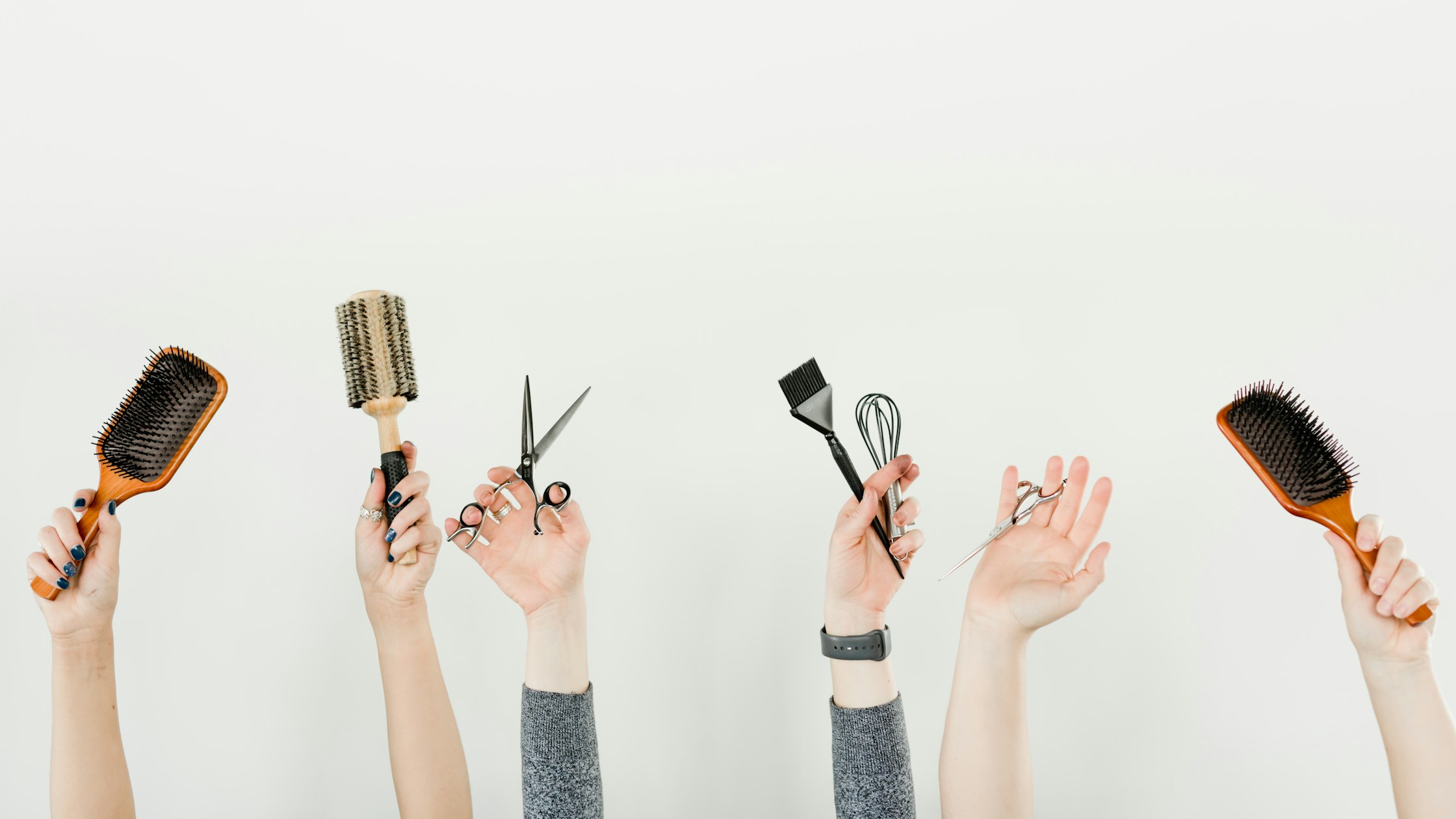

Almost every prospective student we tour at Beyond walks in carrying at least one assumption picked up from a parent, a counselor, or TikTok. Most of those assumptions are wrong. The biggest beauty school misconceptions aren't just inaccurate — they push smart, talented people away from a career that would actually fit them.
Below are the nine we hear the most, and what's actually true. The honest answers come from running a Santa Fe Springs school since 1997 and graduating 2,100+ licensed cosmetologists, estheticians, and nail techs.
Misconception 1: "Beauty school is a backup plan for people who couldn't get into college"
This one needs to die. Beauty school is a credentialing program for a regulated profession. California requires 1,000 hours of cosmetology training, a state board exam, and a state license to legally cut hair for money. That's not a backup — that's a deliberate professional path with real entry requirements.
Many of our students chose Beyond over a four-year college because the math made sense: $17,560 total versus $50,000+ for one year of private university; eight months to a paycheck versus four-plus years; a real, salable license versus an undecided major.
Misconception 2: "Stylists don't make money"
Income in beauty depends on three things: city, specialty, and clientele. Top stylists in LA and Orange County clear six figures. Master colorists, balayage specialists, and editorial stylists charge $200+ per service. Brand-new licensees start lower — typically as assistants or junior stylists — and grow income as they build a book.
The U.S. Bureau of Labor Statistics tracks barbers, hairstylists, and cosmetologists as a real occupation with steady wage data; check the Occupational Outlook Handbook for the latest numbers. The honest version: this is a hustle career. The ceiling is high. The floor depends on you.
Misconception 3: "Beauty school takes years"
It does not. Here are Beyond's actual program lengths full-time:
- Cosmetology: 1,000 hours, ~8 months (daytime schedule)
- Esthetician: 600 hours, ~5 months day (about 7.5 months for the part-time and evening tracks)
- Manicuring / Nail Tech: 400 hours, ~5 months (evening only)
You can be licensed and working before the next high school class graduates.
Misconception 4: "Financial aid isn't available for beauty school"
It is, for accredited schools. Beyond is NACCAS accredited and approved by the California Board of Barbering and Cosmetology. Our cosmetology and esthetician programs qualify for federal Title IV aid — Pell Grants (up to $7,395 for the 2026-27 award year) and federal student loans. FAFSA school code: 041482.
The manicuring program is shorter than the federal threshold and doesn't qualify for federal aid, but the $5,595 total tuition is manageable on a monthly payment plan. Full financial aid breakdown here.
Misconception 5: "I'm too old to start"
This is the objection we hear most from adults in their 30s and 40s and beyond, and it has the least behind it. California sets a minimum age — you must be 17 to sit for the state board exam — and no maximum. There is no age at which the Board stops issuing licenses.
In practice, older students often do better. They already know how to show up on time, handle a difficult client, and finish what they start, which is most of what separates a licensed professional from a good one. The technical skill is what school teaches. The rest you've been practicing for twenty years.
The real question for a career-changer isn't age, it's schedule. Cosmetology at Beyond runs daytime only. Esthetician and manicuring both have evening tracks, which is what makes them workable while you keep a day job. Match the program to the hours you actually have, not the license that sounds best. More on California's age requirements here.
Misconception 6: "You'll just be cutting hair"
A California cosmetology license is the broadest beauty license in the state. It legally covers hair (cut, color, chemical, blowouts, treatments), makeup and strip lash application, lash and brow tinting, lash extensions, lash lifts and brow lamination, basic skin services (facials, dermaplaning, microdermabrasion, superficial chemical peels, microcurrent), and nails (manicures, pedicures, gels, acrylics, hand and foot massage).
A few of those come with limits worth knowing before you advertise them. Peels must be superficial only — medium- and deep-depth peels are out of scope for cosmetologists and estheticians alike. Microcurrent devices have to be set to stimulate the muscle, not contract it. And the universal line is that nothing you perform may break the skin below the epidermis or cause bleeding, bruising, or scabbing, which is why microneedling is prohibited while microdermabrasion is fine.
The license does not cover injections, lasers, IPL, microneedling, body contouring, or anything requiring a medical credential. We teach the boundaries clearly because misunderstanding scope of practice is the #1 reason new licensees get cited. Read our full scope-of-practice guide.
Misconception 7: "AI and tech will replace beauty workers"
This one deserves a real answer rather than a wave-off, because AI is already changing parts of this business. Booking, reminders, marketing, captions, and bookkeeping are being automated right now, and virtual try-on and color-visualization tools keep getting better. Anyone telling you AI has nothing to do with beauty isn't paying attention.
What's different about this trade is where the value sits. The service itself is physical, sensory, and performed on another person in real time — reading porosity by feel, adjusting a formula mid-process, keeping a nervous client calm through a chemical service. Those are among the hardest tasks to automate, and the major studies of AI exposure consistently put personal-care work near the bottom of the list while office and administrative roles sit near the top.
The honest framing: AI is far more likely to take over the admin around your chair than the work in it, and the pros who learn to use it on the business side will have an edge. We went through the actual research here.
Misconception 8: "You need to be artistic to enroll"
Helpful, not required. Plenty of our top students started with shaky technique and ended with a sharp eye and clean execution because of repetition. Beauty school is structured to build skill: theory, demos, hours of practice on mannequins, then real clients on the student floor. If you have patience and care about your craft, the artistry comes.
Misconception 9: "Cosmetology school is easy"
It isn't. Students log 1,000 hours, learn chemistry (cuticle, lift levels, pH, neutralization), pass the written state board exam, and meet attendance and check-off requirements throughout. The work is hands-on, not lecture-heavy — but it's still work. Students who treat it like a hobby don't pass the board. Students who treat it like training for a career do.
What's actually true about beauty school
- It's a regulated, licensed profession with real entry requirements
- It costs less and takes less time than a four-year degree
- The license itself is portable — it follows you to any salon, city, or business you work in
- Income scales with your skill, specialty, and book of clients
- Federal aid exists for the longer programs at accredited schools
- There's no upper age limit, and no artistic prerequisite
- The work is hands-on, social, and tactile — well-suited to people who hate desks
Get the real picture — tour Beyond
The fastest way past the misconceptions is to walk through a real beauty school during class hours. Schedule a tour or call us at (562) 404-6193. We're at 13640 Imperial Highway, Suites 6-8, Santa Fe Springs, CA 90670. You'll see the floor, meet instructors, and get straight answers — including any misconception we didn't cover here.


