


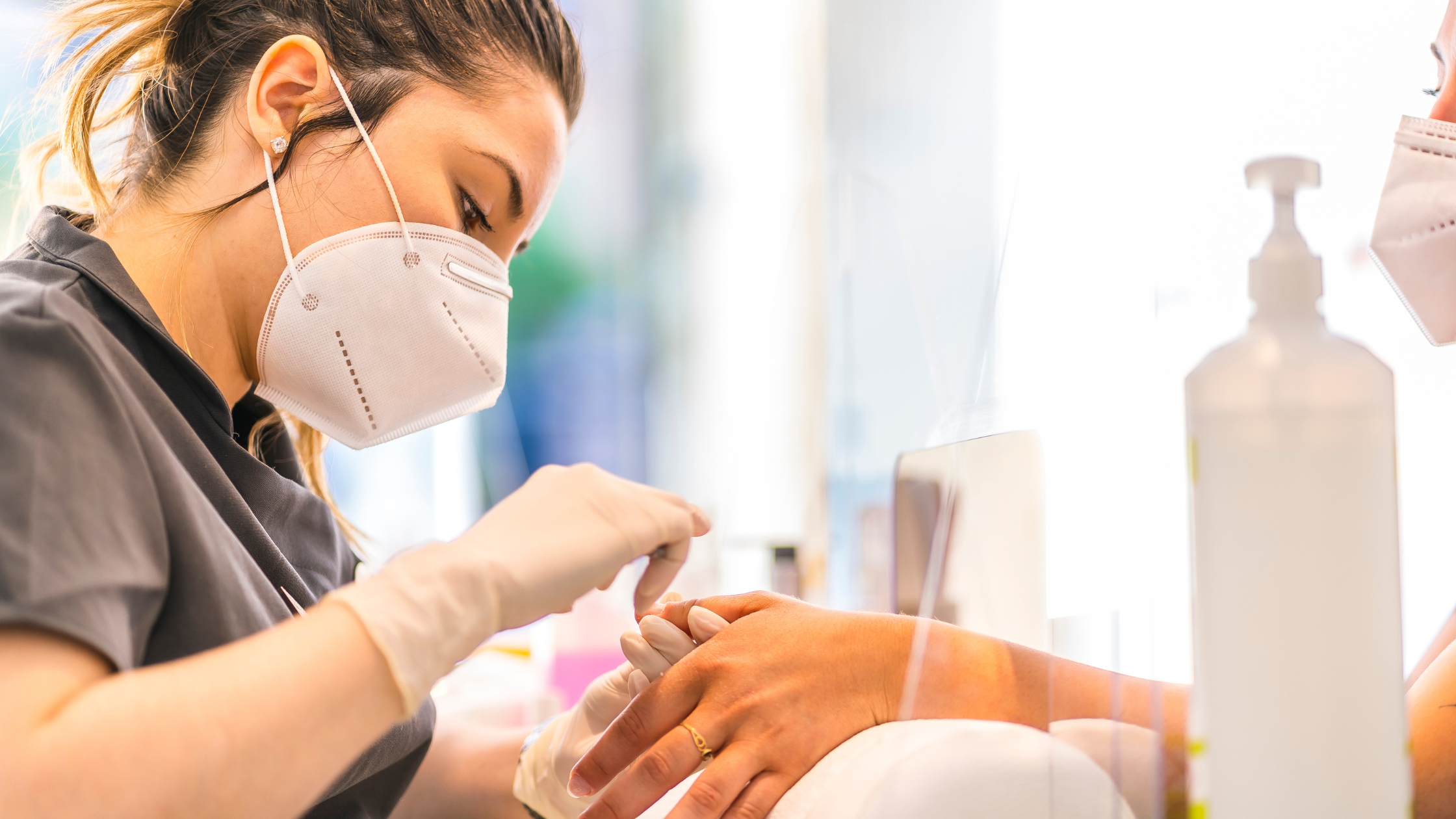

If you follow industry news in beauty or chemistry, you have probably seen methyl methacrylate — MMA — mentioned somewhere. Usually it comes up around an industrial accident at a plastics or aerospace facility, or in a story about a low-cost nail salon getting cited by inspectors. It is the same compound in both contexts. And in the nail world specifically, MMA has been one of the most consequential and controversial ingredients in the industry's history.
This is a plain-language explanation of what methyl methacrylate is, how it ended up on manicure tables in the first place, why regulators went after it, and why it still occasionally shows up in salons today.
The short version
Methyl methacrylate is an industrial monomer originally developed for plastics and dentistry. In the late 1960s and early 1970s, nail technicians began using dental-grade MMA to create acrylic nail enhancements. The product caused so many injuries — nail loss, severe allergic reactions, permanent loss of sensation in the fingertips — that the U.S. Food and Drug Administration took court action against manufacturers in the mid-1970s. Today, MMA in nail products is prohibited by more than 30 U.S. states. California has banned possession of MMA monomer in licensed salons and cosmetology schools since 1994 — one of the longest-standing salon-chemical rules in the country.
What methyl methacrylate actually is
MMA is an organic compound with the chemical formula C5H8O2. At room temperature it is a colorless, flammable liquid with a sharp, fruity odor. It is a monomer — a small molecule that, when polymerized, links into long chains to form poly(methyl methacrylate), or PMMA.
You have almost certainly used PMMA in some form today. It is the rigid, glass-like plastic in acrylic sheet (Plexiglas, Perspex), in many automotive lenses and tail lights, in aerospace composites, in bone cement, in dentures and dental crowns, and in some intraocular lenses for cataract surgery. Polymerized MMA is inert, durable, and biocompatible enough that it has been implanted in human bodies for decades.
The trouble is not with the polymer. The trouble is with the liquid monomer before it polymerizes — which is exactly what nail technicians work with at the table.
How MMA ended up in nail salons
Acrylic-based dental products had been used since the early 1950s to make dentures and crowns. Dentists relied on MMA liquid mixed with PMMA powder because the resulting material was hard, lightweight, and could be sculpted in place.
In the late 1960s and early 1970s, as the professional nail enhancement industry was in its infancy, technicians began repurposing dental-grade MMA and PMMA powder to sculpt artificial nails. These products were often marketed as "dental acrylics" or "porcelain nails." There was very little formal product chemistry education in the early industry, and few standardized protocols for what was safe to put on a client's hand.
Why MMA became a serious problem
The injuries showed up quickly. The FDA began receiving complaints in the early 1970s. Among the harms documented:
- Severe contact dermatitis around the cuticles and fingertips, often progressing to permanent allergic sensitization
- Loss of the nail plate, sometimes permanent, with no regrowth
- Loss of sensation in the fingertips
- Nail bed deformity
- Onycholysis — the nail lifting away from the nail bed
Two structural problems made MMA especially damaging for nails.
Poor adhesion. MMA does not bond well to the natural nail plate. To get it to stick, technicians had to aggressively grind the surface of the nail with coarse-grit files, stripping protective layers of the nail before any product went on. The physical damage from filing compounded the chemical exposure.
Extreme rigidity. Once cured, MMA nails were exceptionally hard — harder than the natural nail underneath. When the enhancement caught on something, the natural nail typically gave way first. Clients literally had nails ripped off because the artificial nail did not break the way a softer acrylic would have.
The FDA response — and the "ban" misconception
By the mid-1970s, the FDA had received enough complaints to act. The agency pursued court action against several manufacturers of MMA-based nail products, secured a preliminary injunction against at least one company, and led seizure actions and voluntary recalls of products containing 100% MMA monomer.
This is the part that gets oversimplified. There is no formal FDA regulation that specifically prohibits methyl methacrylate in cosmetic products. The FDA's published position is that liquid MMA, when used in fingernail preparations, is a "poisonous and deleterious substance" — but that position has been enforced through case-by-case litigation, not through a comprehensive rule. Saying MMA is "banned by the FDA" is the common shorthand, but the technical reality is messier.
How California regulates MMA
States stepped in where federal regulation did not, and California was among the earliest and strictest. The state's prohibition was filed on October 24, 1994 and became operative on November 23, 1994. It is codified at California Code of Regulations, Title 16, Section 989, and the rule states plainly that no licensed establishment or school shall have methyl methacrylate monomer (or methylene chloride) on the premises. The regulation was later amended in 2015, but the core prohibition is more than thirty years old — one of the longest-standing salon-chemical rules in the country.
In practice, that means:
- Licensed salons and schools in California cannot have or use MMA-containing nail products at all — possession alone is a violation, not just application on a client
- Establishments must keep a Safety Data Sheet for every hazardous chemical used
- BBC inspectors check for prohibited products during routine inspections
- Violations carry administrative fines
The Board of Barbering and Cosmetology continues to issue periodic reminder bulletins to licensees and consumers, because despite three decades of enforcement, MMA still resurfaces in low-cost salons. In December 2025, the California Department of Toxic Substances Control adopted a regulation listing nail products containing MMA above 1,000 parts per million as a Priority Product under the Safer Consumer Products program. Manufacturers and distributors of such products now must either reformulate or perform a formal alternatives analysis before continuing to sell in California. DTSC's own findings noted that despite the BBC prohibition, MMA continues to be detected in indoor air at California nail salons and in some retail nail products sold for home use.
Why MMA still shows up
The answer is almost always price. MMA monomer is materially cheaper than EMA — often a third the cost or less, depending on the brand and quality of the compliant product it is being compared to. For a salon doing dozens of full sets a week, that gap compounds fast. Establishments competing almost entirely on the lowest possible price have a financial incentive to use MMA, and some do, knowingly or not.
Mislabeling is part of the problem. Because MMA is prohibited in licensed California establishments, it is not going to be listed as "methyl methacrylate" on a bottle sold to a salon. It may be repackaged, imported under unclear ingredient lists, or labeled simply as "monomer."
How to tell if a salon is using MMA
You usually cannot read it off the label. But MMA has physical signatures that are hard to hide:
- Smell. A noticeably stronger, sharper, fruitier odor than a normal acrylic monomer. It is the chemical signature inspectors learn to recognize first.
- Hardness. The cured product is unusually hard and very difficult to file with standard salon abrasives.
- Refuses to soak off. MMA enhancements will not dissolve in acetone or other solvents designed to remove acrylics. If a salon has to drill nails off rather than soaking them, that is a red flag.
- Cloudy finish. The cured material can have a milky or cloudy appearance instead of being crystal clear.
- Price. A full set significantly below local market price deserves a second look.
What compliant acrylic systems use instead
The standard monomer in legitimate acrylic nail systems is ethyl methacrylate (EMA). EMA's molecule is larger than MMA's, which means it is significantly less able to penetrate skin and underlying tissue. The Cosmetic Ingredient Review Expert Panel reviewed EMA in 2002 and found it safe for use in nail products when application is accompanied by directions to avoid skin contact.
Beyond EMA-based liquid-and-powder acrylic, the modern professional nail toolkit includes:
- UV- and LED-cured hard gel
- Gel polish
- Soft gel tip extensions, like Aprés Gel-X
- Dip powder systems
- Nail wraps
One nuance worth knowing: polymerized MMA — that is, PMMA — is still present in many nail powders and is considered safe. Once methyl methacrylate has reacted into a polymer, it is no longer the same compound in any meaningful chemical sense. It is the liquid monomer applied directly to skin and nail that causes the harm.
MMA outside the nail industry
Methyl methacrylate is manufactured globally in enormous volumes — more than three million metric tons per year — for plastics, paints, coatings, adhesives, dental materials, and aerospace composites. Industrial incidents involving bulk storage of MMA have happened periodically, sometimes prompting large-scale evacuations because the liquid is highly flammable and the vapor irritates the respiratory tract. Those incidents involve concentrations and quantities that are not comparable to what shows up at a salon table, but it is the same compound. The chemical's reactivity is what makes it useful at industrial scale and what makes it hazardous when something goes wrong.
The takeaway
For clients, the practical guidance has not changed in decades: trust your nose, be skeptical of prices well below local market, and choose a salon where you can see the products being used. If your enhancements are damaging your natural nails, the product matters as much as the technique.
Product chemistry is part of the curriculum that licensed nail technicians study in California, and the distinction between MMA, EMA, polymers, and gel systems is foundational to the work. Related reading: our manicuring program overview, the programs hub, the school FAQ, and the free manicurist state board practice exam.


