


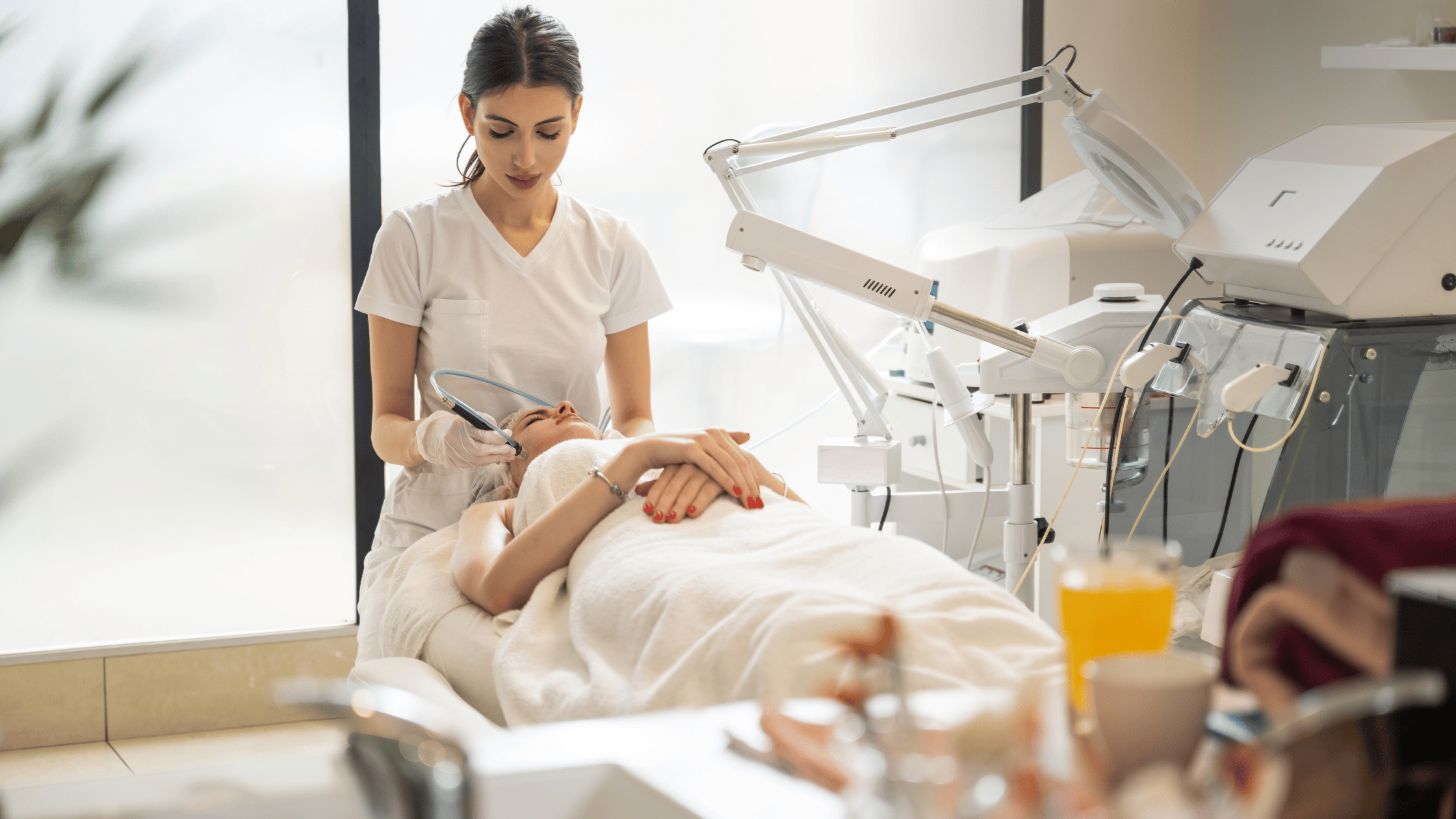
If you've researched becoming a medical esthetician California professional, you've probably run into a confusing wall of information, with some schools advertising a separate "medical esthetics" credential. So let's clear it up directly: California does not issue a separate "medical esthetician" license. There is one esthetician license issued by the California Board of Barbering and Cosmetology, and it's the legal credential behind both the spa esthetician and the so-called medical esthetician. The difference isn't the license. It's the setting, the role, and who you work alongside.
Understanding that distinction up front saves you money and disappointment, because you don't need to chase a credential that doesn't exist. You need the esthetician license plus the right experience.
One license, two work settings
A licensed esthetician in California performs skin-care services: facials, exfoliation, extractions, hair removal, makeup, and lash and brow work, within the scope the BBC defines. That's true whether you work in a day spa or a dermatology office.
"Medical esthetician" is a job title, not a license tier. It generally describes a licensed esthetician who works in a medical or clinical environment, a dermatology practice, a plastic surgery office, or a medical spa, often supporting or working alongside a physician or other medical provider. The work tends to lean toward clinical skin care: pre- and post-procedure skin support, advanced facials, and helping clients through treatment plans a provider has set. But the underlying legal credential is the same esthetician license you'd earn for spa work. You may also see this role written as "aesthetician" with an "a." In California it is the same license, a distinction we unpack in esthetician vs. aesthetician.
Where scope-of-practice limits come in
This is the part people most often get wrong, so it matters. The esthetician license has defined limits on what procedures you can perform. More advanced or invasive treatments, certain laser and energy-based procedures, injectables, and other medical-grade interventions, are generally restricted and may require a licensed medical professional, performed under medical supervision, or are outside the esthetician scope entirely. Working in a med spa does not expand what your esthetician license allows you to do with your own hands. The setting changes; the scope of your license doesn't.
Because these scope lines are specific and do get updated, anyone planning advanced or clinical work should confirm the current boundaries directly with the BBC and the supervising medical provider rather than assuming. What you can legally do is tied to your license and the supervision structure, not your job title.
How to actually become a "medical esthetician"
If clinical skin care is your goal, here's the honest roadmap:
- Earn your California esthetician license. That's the foundation and the legal credential. At Beyond, the esthetician program is 600 hours, runs day or night, and costs $11,206.50. As a Dermalogica partner school, the training is grounded in professional skin-care science, which is exactly the foundation clinical settings value.
- Build skin-care experience. Most medical settings want estheticians who are confident with skin analysis, treatment protocols, and client care before they bring you into a clinical environment.
- Add advanced or clinical training. Many estheticians pursue additional, focused education in clinical or "medical" esthetics after licensing. Just remember: those courses build skill and resume strength, but they don't change the scope of your underlying esthetician license.
- Find the right setting. Apply into dermatology offices, plastic surgery practices, or medical spas where you'll work under or alongside a medical provider.
So the same license opens both doors. The "medical" version is the esthetician license plus experience, plus advanced training, plus a clinical employer.
Which path makes sense for you?
If you love skin and want a clinical, results-focused environment, the medical-spa route can be rewarding and is often well-compensated relative to general spa work, though pay varies by employer and region. If you prefer a more relaxed, full-service spa atmosphere, traditional esthetics may suit you better. Either way, the first step is identical: get licensed. You don't have to decide your final setting on day one. You can explore the program among our other beauty programs and figure out direction as you train.
The bottom line
Don't get confused by extra certifications claiming "medical esthetician license" in California, because there isn't one. There's one esthetician license, and a clinical career is built on top of it with experience and advanced training.
Start with a strong esthetician foundation at Beyond
Whether you're aiming for a med spa or a day spa, it starts with the same license, and we'll help you get there. Beyond 21st Century Beauty Academy has trained licensed beauty professionals since 1997, with more than 2,100 graduates licensed in California.
Book a campus tour, call (562) 404-6193, or visit 13640 Imperial Highway, Suites 6-8, Santa Fe Springs, CA 90670.


